Home » Installing the VFD » Electrical Installation » Main electrical lines and motor connections » Grounding
The Clean Power VFD must be connected to the earth ground of the AC supply.
Ensure that grounding wires meet the technical standards for electrical equipment.
Impedance must conform to national and local regulations, safety regulations, and electrical codes
Furthermore, ensure that the length of grounding wires is minimized.
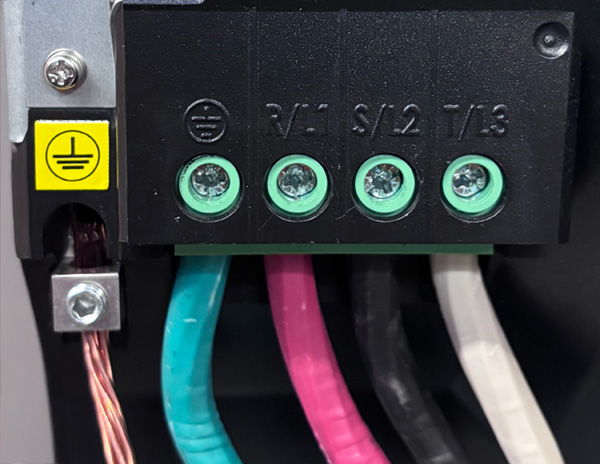
The Clean Power VFD has 2 earth (ground) terminals that must be securely connected to the earth ground before use.


ELECTRIC SHOCK CAUSED BY LEAKAGE CURRENT
Failure to follow the following instructions may result in death or serious injury.The Clean Power VFD enclosure has been designed with materials that ensure electrical isolation. Despite this, there is the possibility that small leakage currents may still be present.
1- Verify compliance with all local and national electrical code requirements as well as all other applicable regulations for grounding the entire Clean Power VFD.
2- The Clean Power VFD must be connected to low-impedance earth ground to mitigate the risks posed by these leakage currents. Proper grounding eliminates the risk of electric shock due to the leakage current when touching the Clean Power VFD case.
3- Ground the Clean Power VFD before applying voltage.
4- The size of the protective grounding conductor must meet the relevant standards.
5- Avoid using conduits as protective ground conductors; instead, install a protective ground wire inside the conduit.
6- Cable shields should not be regarded as protective ground conductors.
7- Secure the grounding screws following the guidelines outlined in the Power terminals specification section of this user guide.
In addition to mitigating leakage current, a good low-impedance ground is important for the correct functioning of EMI-sensitive equipment, it reduces the impact of electrical noise in the installed environment.
To ensure proper operation and avoid potential issues such as ground loops, noise interference, and malfunctions, please follow the following recommendations :
- Ensure proper grounding of the VFD: Proper grounding is essential for the safe and reliable operation of the VFD. Follow the guidelines and recommendations for grounding practices. This includes connecting the VFD's ground terminal to a suitable grounding point.
- Do not connect the 24VDC common terminal to the ground: It is important to note that the common terminal of the 24VDC input power supply should not be connected to the ground. This helps prevent ground loops and potential issues arising from a difference in ground potential between different points of the circuit. The 24VDC common terminal should be connected only to the appropriate DC power supply and not to the ground.
- Separate the grounding of the VFD from other power equipment: To minimize the risk of interference and ensure proper operation, it is recommended to separate the grounding of the VFD from other power equipment. This means avoiding sharing grounding wires between the VFD and other equipment, such as welding machines or other electrical devices. Separate grounding helps maintain a clean ground reference and reduces the risk of noise interference.
- Ensure proper cable routing and shielding, if necessary: Proper cable routing is crucial for minimizing interference and maintaining signal integrity. Make sure to route the cables in a neat and organized manner, keeping them away from potential sources of electromagnetic interference. Additionally, if necessary, consider using shielded cables to further reduce the risk of noise interference.
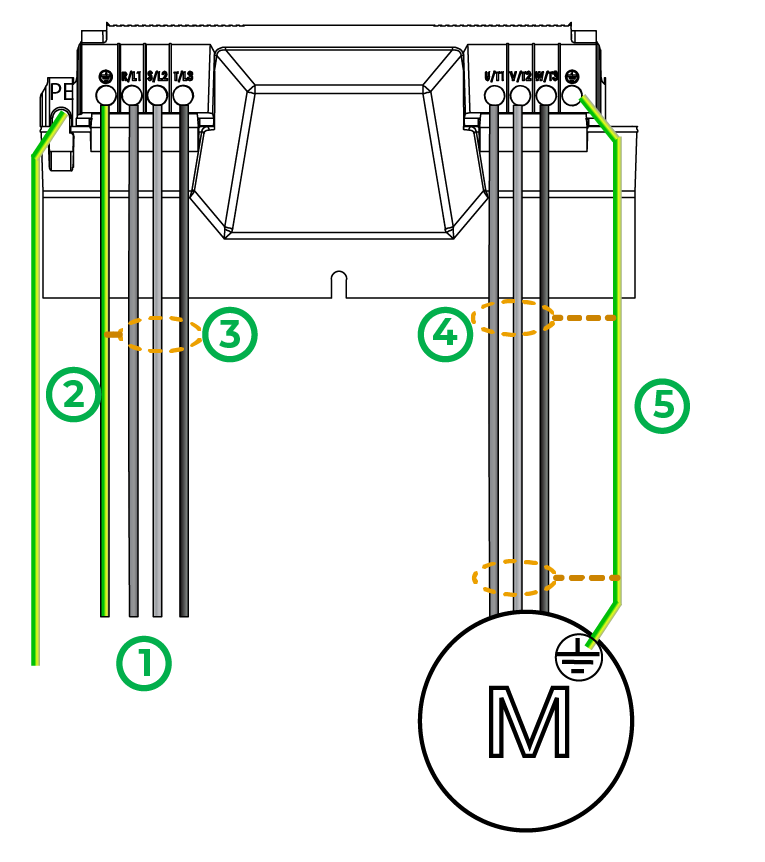 |
1 : Power Supply: The connection to the power source must fulfill power cable and fuses specifications as recommended in this user guide. 2 : If the conductivity of the shield does not meet the standards for a PE conductor, use either a dedicated grounding PE cable or a cable that includes a separate PE conductor. 3: It is recommended to use 360-degree grounding when shielded cable is utilized. Connect the opposite end of the input cable shield or PE conductor to the ground at the distribution panel. 4: It is recommended to use 360-degree grounding. 5: IEC 61439-1 emphasizes that all conductors, including shields, must meet specific standards for conductivity and safety. |