Home » Functions and parameters » Motor Control Mode » General » Automatic restart
Introduction
The Automatic Restart feature allows the Variable Frequency Drive (VFD) to restart the motor from a fault clearance automatically, provided certain conditions are met.
This section outlines the procedure for enabling and configuring this feature and the safety precautions and operational details involved.
Enabling Automatic Restart
To enable the Automatic Restart feature, follow these steps:
- Navigate to the Automatic Restart Setting: Access the settings menu on the VFD interface.
- Enable the Feature: Select the option to enable Automatic Restart.
User Warning and Acknowledgement
The VFD will display a warning message when enabling the Automatic Restart feature.
This message informs the user that an automatic restart may present a danger and that proper safety measures must be taken before proceeding.
The user must acknowledge this warning by confirming that the necessary safety precautions have been implemented. This confirmation will be recorded in the VFD's audit logs.
Automatic Restart Function
Once the Automatic Restart feature is enabled, the following conditions and procedures apply:
- Lockout Mode: The VFD will not initiate a motor restart in lockout mode. The user must resolve the issue that caused the lockout and reset the VFD. After resetting, the user must start the motor manually.
- Ramp-Up Procedure: When the VFD initiates an automatic restart, it will apply a ramp-up to bring the motor to the preset speed setpoint after the configured restart delay.
- Tracking Restart Attempts: The VFD will increment the number of restart attempts with each attempt. It will maintain a record of the number of automatic restart attempts and the number of successful automatic restarts as part of its operational data.
Successful Restart
If the automatic restart is successful and the motor reaches the running state, the VFD will reset the number of restart attempts to zero.
Failed Restart
In the event of a failed restart, the following conditions apply:
- Restart Attempts: If the number of restart attempts is less than or equal to the configured maximum number of attempts, the VFD will wait for the configured delay before initiating another restart attempt.
- Maximum Attempts Reached: If the number of restart attempts reaches the maximum configured limit, the VFD will generate a critical alarm indicating that the automatic restart has failed. The user must then reset the VFD and manually restart the motor.
User Control Override
Suppose a Start or Stop command is received from either local or remote control during the automatic restart process. In that case, the VFD will cancel the automatic restart operation and reset the attempts counter.
Parameters:
- Automatic restart delay: Value is settable from 10 to 4000 seconds, default = 10 seconds.
- Maximum number of restart attempts: user-settable from 1 to 10, default = 10.
Criteria for Automatic Restart
- Successful Restart Criteria: The criteria for a successful automatic restart is that the motor reaches the running state.
- Alarm and Attempt Count: If the motor fails to restart, the VFD firmware will raise the alarm and increment the automatic restart attempts count. If the VFD fails to restart the motor after the configured number of automatic restart attempts, it will raise a critical alarm and put the VFD in lockout mode.
- Resetting Attempts Count: The automatic restart attempts count is only reset on a successful automatic restart, i.e., when the motor state is running.
- Automatic Restart Delay: The automatic restart delay is used between attempts to ensure that the motor is at a full stop before the next automatic restart attempt.
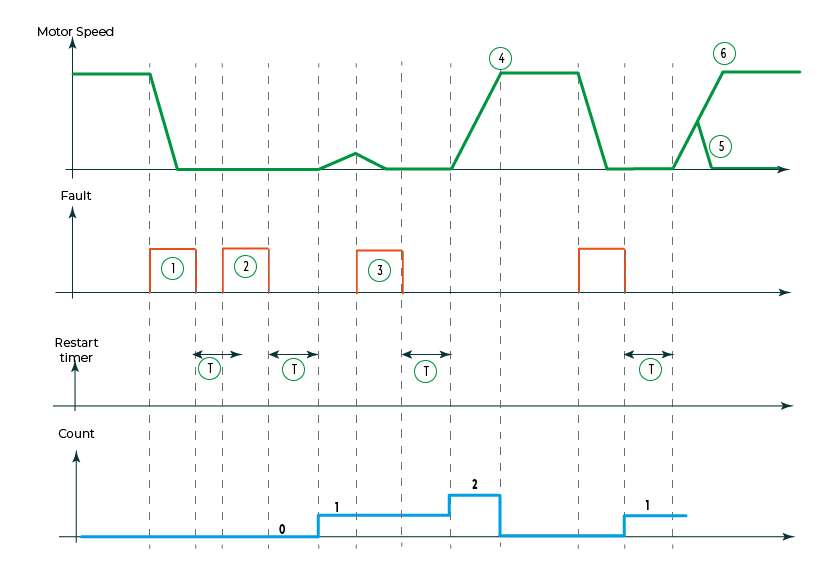
- A fault of medium severity appears, and then the motor decelerates to a stop. When the fault is cleared, the reset timer T starts.
- Before the end of the reset delay, a new fault of severity medium appears, and then the restart process is canceled. When this new fault is cleared, the reset timer starts. When the time has elapsed, the motor restarts and the attempt counter is incremented.
- During the restart ramp-up, another fault of medium severity appears, and then the restart process is canceled, and the accelerating motor is coasting to a stop. When this new fault is cleared, the reset timer starts. When the time has elapsed, the motor restarts, and the attempt counter is incremented.
- The motor is in the correct running state, and the attempts counter is reset.
- During a restart ramp-up, a stop command will override the automatic restart
- During a restart ramp-up, a run command will override the automatic restart