Home » Applications » PID Control
Process control introduction
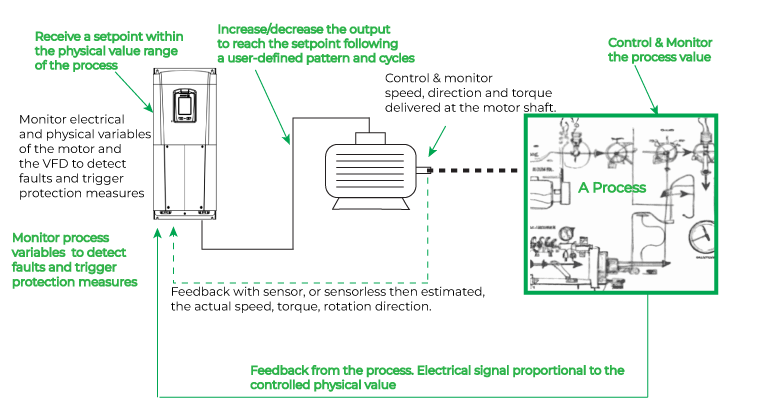
In a controlled process, a desired value of the process is given to the VFD as a setpoint: this is commonly named Setpoint Value (SV)
A sensor measures the process value and sends back this value to the VFD as process feedback: this is commonly named Process Value (PV)
A Proportional, Integral, and Derivative (PID) algorithm adjusts the VFD output (speed/torque) to keep the process feedback value at the setpoint value.
Therefore some settings and parameters must be added to the VFD to achieve this operation.
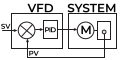
PID Control of the process is a layer over the VFD speed and torque control
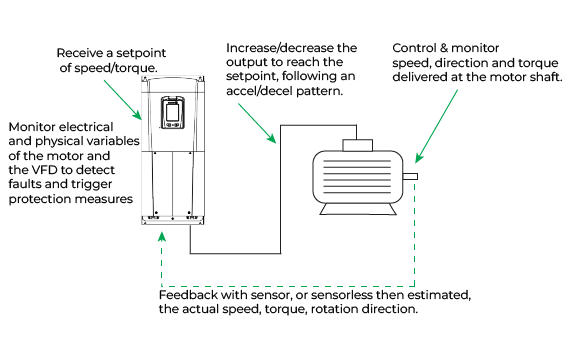
The VFD not only governs the speed and torque exerted at the motor shaft but also ensures the safeguarding of both the motor and the VFD.
It achieves this by monitoring pertinent electrical and mechanical parameters of the motor and the VFD itself, ensuring comprehensive protection.
When managing a process, the VFD effectively regulates and safeguards whatever component is connected to the shaft, while controlling the process.
Controlling the process means delivering the right amount of work accurately and consistently while making sure it stays within the guidelines set by the designer of the controlled process.